

Adaptive Onboarding,
Confident Contractors.
Agentic AI | Mobile | Product | UX
The Product
An AI-assisted mobile onboarding experience that guides independent contractors through identity verification, compliance, contracts, and payment setup. The platform adapts to each company's unique onboarding workflow while providing contextual support throughout the journey.
The Problem
Every contractor onboarding journey was different. Over-customized client workflows, rigid onboarding logic, and little visibility into required documentation created confusing experiences that often led to frustration, abandoned onboarding, and unnecessary support.
The Project
(1) Designed a scalable, workflow-driven onboarding system that adapts to each client's unique compliance requirements.
(2) Reduced uncertainty through contextual AI guidance, helping contractors navigate onboarding with confidence.
(3) Simplified complex verification and compliance workflows to create a faster, more intuitive mobile experience.
Tools | Figma, Adobe Suite, Miro, JIRA
Duration | December 2025 - March 2026
Team | Soul of the Machine Design & Engineering (2 UX, 2 Front-end, 2 RAG, 2 Backend, SotM Leadership) & Openforce Product Team, Engineers + Executive Leadership (14+)
My Role | Design Director
80% +
Legacy abandonment rate addressed
1 -> Many
Reusable framework supporting variable client workflows
AI-Native
Introduced contextual agentic guidance across onboarding
Mobile-First
Unified verification, contracts, and onboarding into one experience.
Impact at a Glance


Background
Openforce, headquartered in Scottsdale, Arizona, provides onboarding, compliance, insurance, and payment solutions for independent contractors across the transportation industry. Soul of the Machine was brought in to redesign the mobile onboarding experience, introducing agentic AI while helping position Openforce as the first-to-market with an intelligent onboarding platform.
During kickoff and discovery, I traveled with Soul of the Machine's leadership team to map existing workflows and uncover the challenges facing both the business and its contractors. As Openforce's CTO put it:
"If we don't innovate, our competitors will - and then we lose."
The urgency was clear. The existing onboarding experience had bounce rates exceeding 80%, with contractors often abandoning the process due to confusing workflows, limited visibility into required documentation, and the inability to pause and resume without losing progress.
We also uncovered a larger product challenge. Years of highly customized client workflows had created a fragmented experience that was difficult to scale and maintain. Rather than continuing to build one-off solutions, our opportunity was to create a configurable onboarding framework that met diverse business needs while delivering a consistent, intuitive experience for every contractor.
As Design Director, I led the UX strategy and design team that transformed Openforce's fragmented onboarding experience into a scalable, AI-assisted, human-centered platform.
Where Business Needs Meet Human Needs
Openforce's challenge extended beyond redesigning a mobile experience - it required balancing complex business requirements with the expectations of the contractors and businesses using it. Years of customer-specific customization had created fragmented workflows and an onboarding experience that no longer scaled.
Contractors needed clarity, flexibility, and confidence - not rigid workflows that punished mistakes or forced them to start over. Our opportunity was to create a configurable onboarding framework that delivered a consistent, human-centered experience without sacrificing business flexibility.
Solving these challenges required a shift in thinking. Instead of designing for individual workflows, we created a configurable framework of reusable task experiences that could adapt to diverse business requirements while maintaining a consistent user experience.
Designing a Configurable Framework
With the challenge clearly defined, our work shifted from understanding existing workflows to identifying the patterns behind them. We evaluated years of client-specific onboarding journeys, separating true compliance requirements from one-off customizations and uncovering opportunities to create a more intentional experience.


Rather than designing dozens of unique onboarding flows, we established a flexible framework built around reusable task experiences. Each task could be configured to meet a client's onboarding requirements while maintaining familiar interaction patterns, allowing contractors to navigate every journey with greater clarity and predictability.
Building an AI-Powered, Modular Experience
The onboarding experience was intentionally modular. Instead of forcing contractors through a single, rigid workflow, each step was designed to solve a specific problem while working together as part of a cohesive, configurable platform. The result was an experience that felt simple for users while supporting the operational complexity behind the scenes.


Together, these modules created a flexible foundation that could adapt to each contractor’s requirements without changing how the experience behaved. But creating a better structure was only part of the challenge. Contractors still needed to understand where they were, what came next, and how to recover when real life interrupted the process.
Designing for Momentum - Introducing VIA
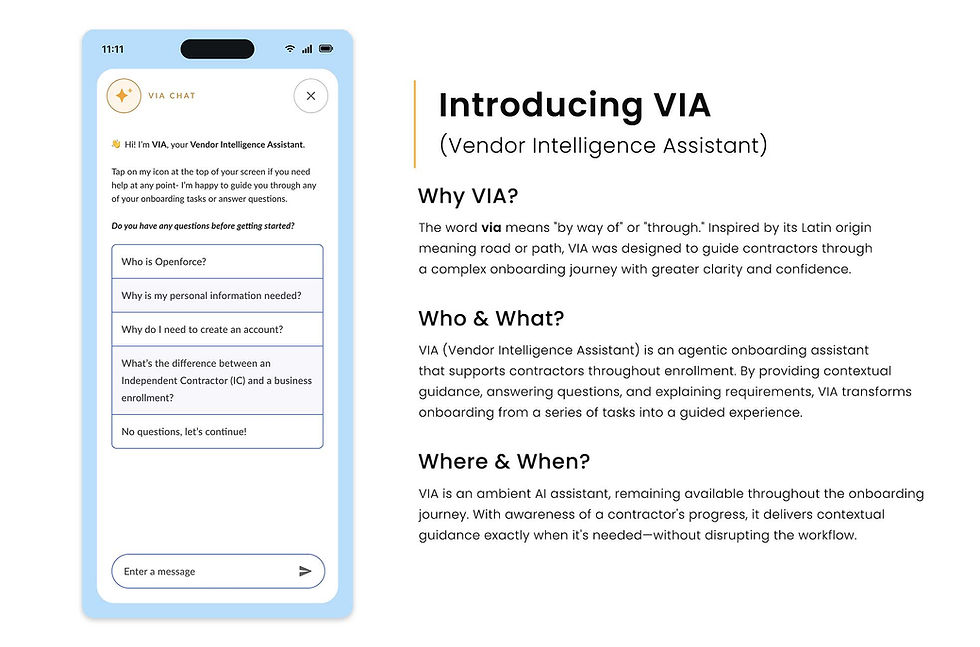
A flexible journey needed an equally flexible guide. I led the creation of VIA—the Vendor Intelligence Assistant—as an ambient, context-aware agent designed to understand each contractor’s onboarding journey and provide support at the exact moment it was needed.
Rather than forcing users down a rigid path, VIA helped preserve momentum—answering questions, providing contextual guidance, remembering progress, and helping contractors confidently pick up where they left off.
Reducing Friction
While VIA provided guidance throughout the journey, the broader experience still needed to make complex onboarding feel manageable. We focused on reducing the effort required to understand progress, prioritize tasks, recover from interruptions, and move confidently toward completion.
Dashboard Design & Iteration
The dashboard became the contractor’s home base—providing a clear view of progress, completed requirements, and what needed attention next. We explored multiple approaches to hierarchy, task status, and progress visualization to find the right balance between guidance and flexibility.
The final direction prioritized overall progress while allowing contractors to move between available tasks, making a complex onboarding journey feel smaller, clearer, and achievable.

AI-Enabled Document Scanner
Contractors were repeatedly entering information that already existed on licenses, registrations, and insurance documents. We designed an AI-enabled document scanner to turn that manual work into a guided capture experience—extracting key information, validating document quality, and pre-populating required fields.

Importantly, automation never replaced user oversight. Contractors could review, correct, and confirm extracted information before submitting, reducing effort without sacrificing accuracy or control.
Designing for Trust
Contractor onboarding requires people to share highly sensitive information—from identity and insurance documents to banking details and legal agreements. Trust had to be earned at every step. We designed the experience to create clarity, reduce uncertainty, and keep contractors in control while helping them confidently move through the onboarding process.
Creating Clarity
Trust begins with knowing what's expected. We surfaced requirements, progress, and next steps throughout onboarding so contractors could prepare before starting and always understand where they stood.
(1) Upfront requirements – Contractors could see the tasks and documentation required before beginning.
(2) Visible progress – Clear task states showed what was complete, in progress, or still needed.
(3) Contextual guidance – VIA explained unfamiliar requirements at the moment users encountered them.


Reducing Uncertainty
Sensitive onboarding tasks create natural moments of doubt. We designed immediate feedback and clear verification states so contractors never had to wonder whether information was captured, accepted, or required additional attention.
(1) Review before submitting — AI-extracted document data remained visible and editable before confirmation.
(2) Clear verification states — Submitted, processing, verified, and needs-attention states removed ambiguity.
(3) Actionable recovery — When something couldn't be verified, users were told what happened and how to resolve it.
Keep People in Control
The previous experience treated onboarding as a single linear session. We designed around real life instead—giving contractors the freedom to pause, correct information, revisit tasks, and continue without sacrificing their progress.
(1) Pause and resume — Progress was preserved across sessions, allowing contractors to return when ready.
(2) Non-linear completion — When possible, users could move between available tasks rather than being blocked by one missing requirement.
(3) Human confirmation — Automation accelerated tedious work without removing the contractor's ability to review, edit, or approve important information.


Trust wasn’t created by any single interaction. It emerged through consistent moments of clarity, certainty, and control across the entire journey. By making system status visible, explaining what was happening and why, and preserving user agency—even when AI was involved—we created an onboarding experience contractors could move through with greater confidence.
These principles became a foundation for the experience, shaping how we approached everything from verification and document capture to contextual AI and progress.
Responsive Considerations
While the experience was designed mobile-first, onboarding didn’t always happen on a single device. Contractors needed the flexibility to move between mobile and desktop without losing context, progress, or access to VIA.
We translated the same modular patterns, task states, and contextual guidance across screen sizes—preserving a consistent experience while adapting interactions to the strengths of each device.

Notable Outcomes
The redesigned experience transformed onboarding from a rigid, interruption-prone process into a more adaptive, flexible journey. Contractors gained clearer visibility into requirements, greater control over task flow, and contextual support when needed, which greatly decreased abandonment rates throughout the onboarding process.
For Openforce, the modular framework created a scalable foundation for onboarding, enabling client requirements to be configured through consistent task patterns instead of bespoke workflows. This gave the product team a clearer path for supporting new customers while gradually accommodating more complex enterprise needs.
Beyond the redesign, the work established a foundation for a more intelligent Openforce platform. VIA, document intelligence, and contextual guidance demonstrated how AI can reduce effort and uncertainty without removing user agency—creating patterns that can extend beyond onboarding into the broader contractor experience.

Reflection / What I learned...
This project reinforced that great UX sometimes requires challenging the system behind the experience—not just the interface in front of it. Openforce’s complexity wasn’t going to be solved screen by screen; it required rethinking how onboarding was structured, configured, and supported.
Leading this work strengthened my belief that scalability and human-centered design aren’t competing priorities. When we design the right foundation, we can give businesses flexibility while creating experiences that feel simple, predictable, and supportive for the people using them.

Responsible AI by Design
AI reduced friction throughout onboarding but was designed to assist—not decide. VIA provided contextual guidance, and document intelligence sped up tedious tasks while keeping contractors in control to review, correct, and confirm their information.

Human Agency
Contractors remained in control of consequential actions and submissions.

Transparency
AI clearly communicated what was happening, why information was needed, and what would happen next.

Review Before Action
AI-extracted information could be reviewed and corrected before submission.

Graceful Recovery
Failed automation offered clear paths to retry, enter manually, or continue another way.

Applied to Openforce
The goal wasn’t to make AI the center of the experience. It was to use intelligence where it could reduce effort, provide clarity, and help people move forward with confidence.